
Bovine Tracheal Cartilage, Type 2 Collagen & Dr. John Prudden
- NXGEN Wholefoods

- Jan 4
- 5 min read
Bovine Tracheal Cartilage is a nourishing food with big benefits.

What Is Bovine Tracheal Cartilage?
Bovine Tracheal Cartilage is a food derived from the trachea of cattle. When prepared properly, it contains a range of beneficial compounds, including non-denatured type 2 collagen.
Dr. John Prudden And The Benefits Of Bovine Tracheal Cartilage
Dr. John Prudden, sometimes known as “the father of cartilage therapy”, was one of the pioneers who discovered many of the benefits that we have come to know about cartilage therapy.
According to Dr. Prudden, “bovine cartilage closely resembles fetal mesenchyme, the primordial tissue from which muscle, bone, tendons, ligaments, skin, fat, and bone marrow all develop.” “The cartilage contains numerous powerful molecular biodirectors.” (Journal of Biological Response Modifiers, 4:583, 1985.)
He conducted much of his research with colleagues at Columbia Presbyterian Medical Center. Initial success led him to test for a variety of possible therapeutic applications. Scores of his patients used it with great success. The benefits they got and much more about the research are described in Dr. Prudden’s 1993 article, A Summary of Bovine Tracheal Cartilage Research Program. Dr. Prudden supervised the investment of over $10 million in research on it. Check out this article for more in-depth information about its benefits.
The full benefits only come to fruition when the sourcing, drying, milling, and delivery systems are done correctly.
How Does Bovine Tracheal Cartilage Work?
How bovine tracheal cartilage works is not fully understood. Depending on the use, the mechanism of action can vary.
For joint health, the supporting compounds, like chondroitin, are broken down, absorbed, and used by the body to support healthy joints.
It is thought that specific proteins and glycosaminoglycans may be used by the body to support a healthy cytokine balance.
It is theorized that the non-denatured type 2 collagen in bovine tracheal cartilage interacts with Peyer’s Patches in the gut to support a healthy immune system.
More research is needed to determine the exact mechanisms of action.
Nutrients in Bovine Tracheal Cartilage
Bovine tracheal cartilage contains:
Glycosaminoglycans and Proteoglycans
Found in connective tissue and are important for structure and water retention in tissues such as bones and joints.
Chondroitin Sulfate
An important component of cartilage that helps it resist compression.
Non-denatured Type 2 Collagen
This type of collagen is found in elastic cartilage and supports joint health.
Amino acids
Glutamine
Proline
Glycine
How Should Bovine Tracheal Cartilage Be Made?
Bovine tracheal cartilage is a very fragile ingredient, so it requires careful manufacturing to protect its key compounds from degradation.
It should start with freshly harvested cartilage, because if it sits around for a while before processing, many of the proteins, enzymes, and other components will begin to break down. Unfortunately, nearly all companies that sell bovine tracheal cartilage don’t produce it themselves, so they don’t control the manufacturing process or know how long the cartilage has been sitting around before it was manufactured.
After the cartilage comes to the facility, ideally directly from the farms, not through a middleman, an enzyme (such as pepsin) should be used to make it easier to digest and absorb. A lot of bovine tracheal cartilage is extracted with acids, which can degrade valuable compounds, but it is a cheaper manufacturing method, so it is often used.
After the enzyme process, it should be low and slow freeze-dried over 48 hours and cryogenically milled. High heat drying and traditional milling methods can damage fragile compounds in it.
Bovine Tracheal Cartilage Sourcing
As with other organs, the source of the animals and their diet matter greatly. The cattle should be raised on regenerative family farms and graze on a wide variety of wild grasses, not confined to feed lots and fed grain. They should not be given hormones, antibiotics, and synthetic feed additives.
If you want the best bovine tracheal cartilage, choose a product that is made with fresh cartilage that can be traced back to the farms and cattle it came from, not just the country of origin. Since very few companies make their own raw materials or finished products, almost none know the exact farms they come from.
What is Bovine Tracheal Cartilage Used For?
Bovine Tracheal Cartilage has many uses. They include nutritional support for:
Healthy joints
Healthy wounds
A healthy immune system
Healthy recovery
How Much Bovine Tracheal Cartilage Should You Take?
The dosing of bovine tracheal cartilage can vary widely depending on its use. The commonly used range is between 2000 and 9000 milligrams (2-9 grams).
Consult with your healthcare practitioner to determine the best dosage for you.
How To Take Bovine Tracheal Cartilage
Bovine tracheal cartilage should be taken with a full glass of water. It can be taken with or without food. If taking more than 2000 mg, it is best to space the doses at least four hours apart, in divided doses of 2000 mg at a time.
It takes time for the full effects to kick in; it’s best to use it for at least three months to see the full effect.
The Best Bovine Tracheal Cartilage & Type 2 Collagen
NXGEN Wholefoods can trace their bovine tracheal cartilage back to the individual farms and cattle from which it comes, an unmatched level of traceability and transparency.
Theirs comes directly from regenerative family farms in the Lake Eyre River basin of Australia. To learn more about the farms and region where it is sourced from, check out our blog. The cattle only eat the wild grasses and are never given hormones, antibiotics, synthetic feed additives, or mRNA vaccines.

In addition, NXGEN Wholefoods manufactures it from freshly harvested cartilage to prevent the degradation that occurs when cartilage sits for long periods.
Once the freshly harvested cartilage arrives at the facility and passes through quality control, an enzyme is applied to improve bioavailability, which is necessary because otherwise it will be poorly absorbed. It is then gently freeze-dried for 48 hours. Not all freeze-drying is the same; it’s important to choose the right type of freeze-drying. You can read more about this here.
After drying, it gets milled into a powder. As with drying, the type of milling process done is critical. Traditional milling generates significant friction and heat (up to 140 degrees), which can damage the fragile compounds. NXGEN Wholefoods uses cryogenic milling to ensure it is cold-milled, thereby avoiding the heat and friction problems associated with traditional milling. You can read more about this here.
After milling, NXGEN Wholefoods encapsulates it in a beef gelatin capsule in their own TGA-certified facility, helping protect it from stomach acid. Finally, it is third-party tested to ensure it is free of pathogens.
To learn more about what makes NXGEN Wholefoods different than other beef organ supplement companies, check out our blog.
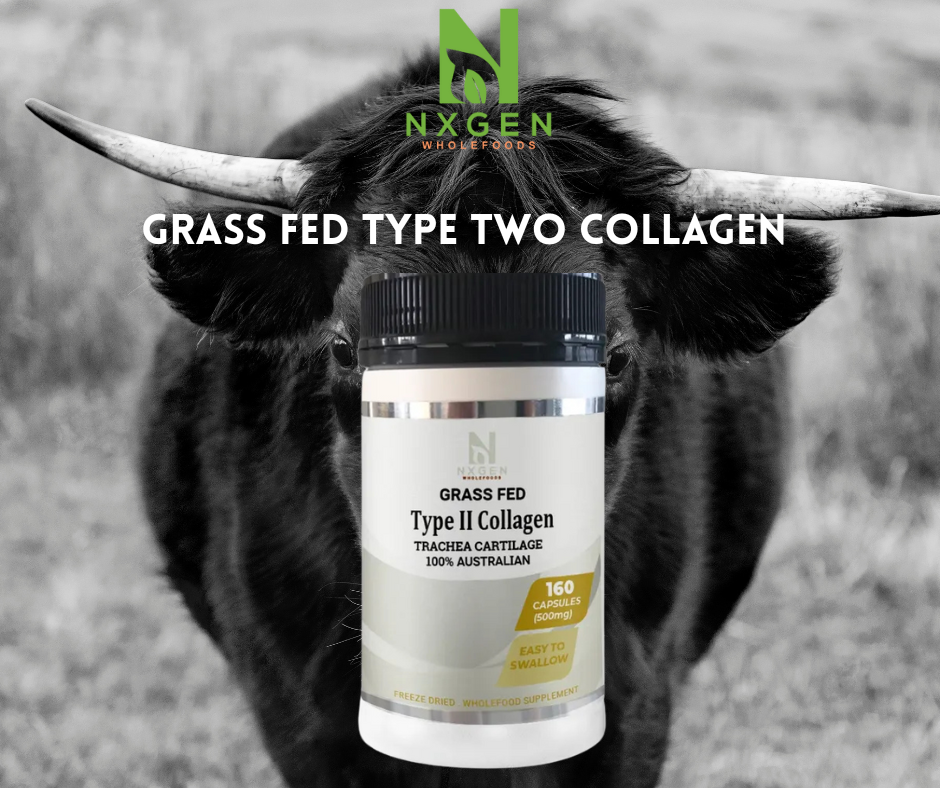
$69.00
Grass Fed Type Two Collagen - Bovine Tracheal Cartilage - 160 capsules
Product Details goes here with the simple product description and more information can be seen by clicking the see more button. Product Details goes here with the simple product description and more information can be seen by clicking the see more button


